Before you start pulling inspiration photos, get a realistic sense of what this actually takes.
– Time: A weekend gets you a solid refresh — new textiles, lighting, a couple of ceramic pieces. Swapping in a new sofa, rug, coffee table, and lighting is a bigger lift, closer to 1–3 weeks once you factor in delivery times and furniture that’s actually worth keeping long-term.
– Budget: A light refresh runs $300–$900 — think lamps, cushion covers, a vase, a throw. A proper room update with a new sofa, rug, table, and lighting lands around $1,500–$4,000. Go higher if you want solid oak instead of veneer or actual hand-thrown ceramics instead of mass-produced ones — this style rewards spending on things you’ll keep for a decade.
– Space: Works best in small to medium living rooms, where negative space (the empty areas you deliberately leave alone) does real visual work. It scales up to bigger rooms too, as long as you resist the urge to fill the extra square footage with more furniture.
– Skill level: Beginner-friendly for styling. Bump up to intermediate if you’re limewashing a wall or refinishing a thrifted table yourself.
– Season: Genuinely year-round. I’ve only ever swapped cushion covers and a throw blanket between seasons — the bones of the room don’t need to change.
What This Style Actually Is
Core palette: warm white, oatmeal, taupe, soft grey, clay, sage, muted brown, charcoal, with black used only in small doses. Skip anything that reads “bright white” or “cool grey” — those belong to a different, harder-edged minimalism.
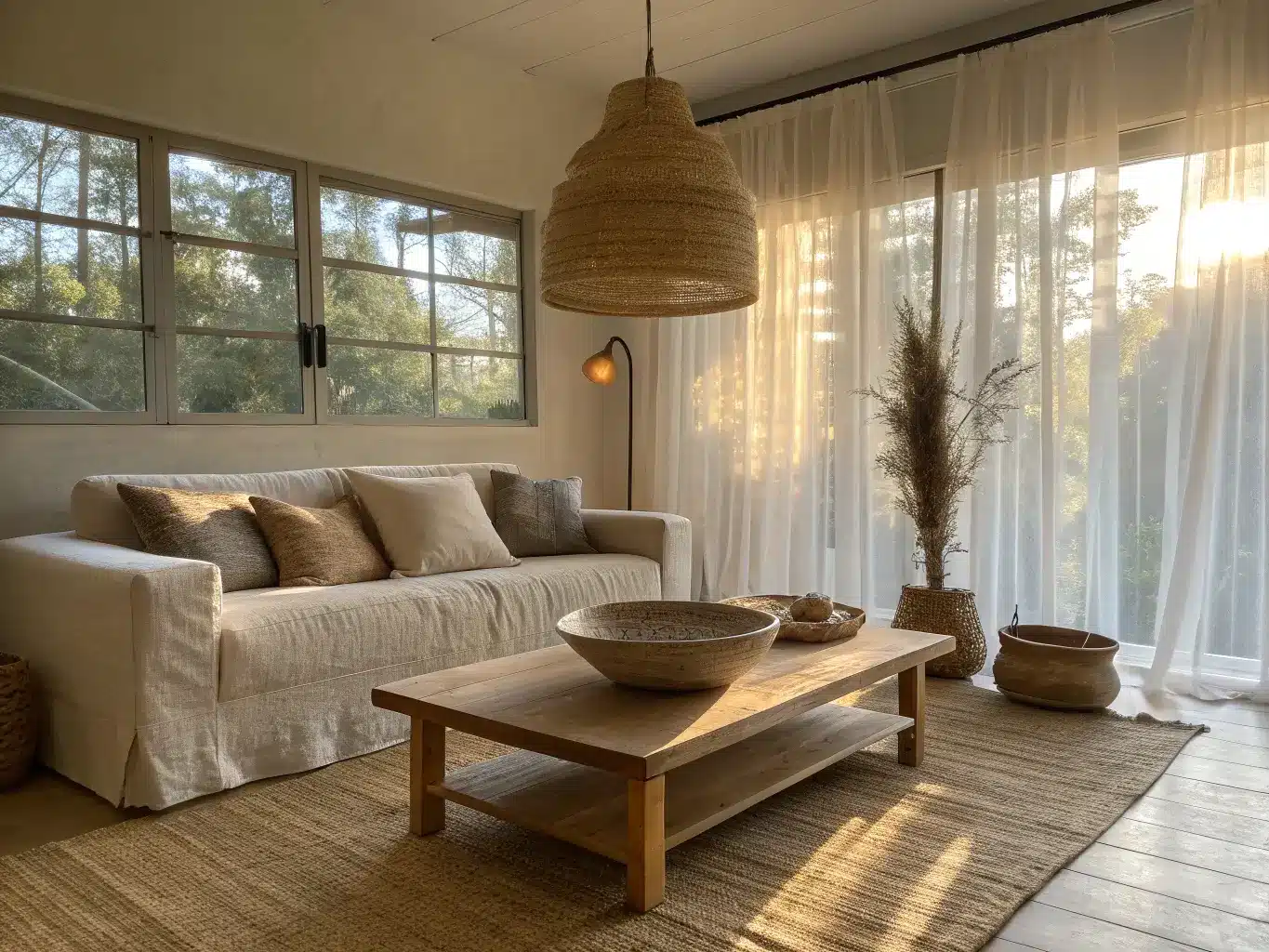
Core materials: linen, wool, cotton, light oak, walnut, bamboo, rattan, raw clay, ceramic, plaster, jute or wool rugs, and wood that’s allowed to show its grain and imperfections instead of being lacquered smooth.
Who it’s for: if you want your living room to feel lived-in and calm rather than staged, this is your style. It’s not for people who want maximalist color or glossy, high-shine finishes.
Must-Have Pieces That Actually Make This Work
You don’t need much. You need the right few things.
– A low-profile sofa in linen, cotton, or wool — oatmeal, sand, or warm white. Low arms, low back, clean lines. I made the mistake of keeping a tall tufted sofa through my first attempt at this look, and it fought with everything else in the room. Once I swapped it for a low linen sofa, the whole space dropped into place — literally and visually.
– A wood coffee table in light oak, ash, or unfinished wood. Simple rectangle or oval. No carved details, no glass top.
– A natural-fiber rug — jute, wool, or a flatweave blend. This is what keeps the room from feeling cold underfoot and visually.
– A paper or fabric lamp. Paper lanterns and rice-paper pendants show up constantly in Japandi rooms for a reason — the light they throw is soft and diffused, nothing like a bare bulb or bright overhead fixture.
– One handmade ceramic piece — a vase, bowl, or vessel with visible glaze variation or a slightly uneven shape. The irregularity is the point.
– One organic accent — a branch, dried pampas grass, eucalyptus stem, or a single plant. One or two, not five.
– A textured wall finish if your walls feel flat — limewash or textured plaster gives you that quiet, slightly imperfect backdrop wabi-sabi is built on.
– Woven baskets or low closed storage to keep surfaces clear without looking bare.
Optional layers worth adding later
– Seasonal accents: dried stems in fall, olive branches in spring, bare branches in winter, lighter linen throws in summer
– Stone trays, raw-edge wood bowls, driftwood-style objects
– A small amount of matte black or dark bronze hardware for contrast — don’t overdo this
– One large abstract or botanical artwork in muted tones, instead of a gallery wall
How to Put It Together
Start with the shell. Warm white or off-white walls, natural wood flooring or a wood-toned rug base. This is your neutral canvas — get it right before buying anything else.
Bring in the big pieces next. Low sofa, simple wood table, natural-fiber rug. These three define the room’s structure. Everything else is decoration on top of that structure.
Layer texture, not color. This is the single biggest lesson I’ve learned with this style: texture does the work that color usually does. Mix linen cushions, a chunky wool throw, a smooth ceramic vase, rough plaster, and grainy wood, and the room feels rich even though the palette barely moves. Add color instead of texture and you break the calm.
Keep contrast restrained. Black shows up as a frame, not a fill — a slim lamp base, thin table legs, a picture frame edge. If black starts showing up as a rug, a sofa, or a big wall moment, you’ve drifted into a different, harder style.
Leave space alone. Don’t fill every shelf or every inch of the coffee table. A single vase on an otherwise empty console table reads as intentional. Five objects crowded together reads as clutter, no matter how nice each one is individually.
Pick one focal point. A sofa-and-rug grouping, a textured accent wall, or one sculptural vase — choose one and let it lead. Competing focal points are what make rooms feel busy even when they’re technically minimal.
Let symmetry be a little off. Two lamps that don’t quite match. A vase placed slightly off-center. Furniture at varied heights. This is where wabi-sabi actually shows up — perfect symmetry belongs to a more formal, polished look.
Budget: Where to Spend, Where to Save
Spend on:
– The sofa — you sit on it daily, and cheap linen-blend upholstery pills and sags within a year
– The coffee table — solid wood ages well; veneer chips and looks tired fast
– Lighting — a well-made paper or fabric-shade lamp runs $60–$200 and is worth it over a flimsy $20 version that yellows in six months
Save on:
– Accent decor — vases, small ceramics, and throws in the $25–$75 range are genuinely fine to buy budget, especially secondhand
– Art — a large muted print doesn’t need to be original work
– Storage baskets — thrifted or from a home goods store, nobody’s checking the label
My best ceramic piece, honestly, cost me $12 at a flea market — a slightly lopsided stoneware bowl with a cracked glaze that I almost put back because I thought it looked “broken.” That bowl is now the thing people ask about most when they’re in my living room. That’s wabi-sabi working exactly as intended.
Common Mistakes That Undercut the Look
– Going too sterile. Strip out every texture and pattern and you don’t get Japandi — you get a doctor’s office. Warmth has to survive the editing process.
– Overdecorating surfaces. If your coffee table has six objects on it, take four away. Negative space isn’t empty space — it’s space doing a job.
– Choosing shiny, overly finished materials. Glossy lacquer, polished chrome, high-shine ceramics — none of it belongs here. Matte, raw, and slightly weathered beats polished every time.
– Picking the wrong white. A stark, cool white paint fights everything else in the room. Look for warm whites with a hint of beige or grey undertone instead.
– Forgetting comfort. A beautiful linen sofa that’s too firm to actually sit on defeats the entire point. Warm minimalism means warm — sit on it before you buy it.
– Buying a matching set. A sofa, chair, and table all from the same collection looks like a showroom, not a home. Mix sources. Let pieces feel gathered over time instead of ordered off one page.
Keeping It Fresh Without Losing the Look
Stick to your warm neutral base — that’s non-negotiable. But limit yourself to one or two accent colors beyond it, like sage or clay, so new purchases don’t start pulling the room in different directions.
Re-edit often. Every few months, pull one thing off a shelf or swap a throw. The room should feel like it’s evolving slightly, not sitting frozen.
Seasonal swaps that take an afternoon:
– Heavier wool throw and darker stems in winter
– Linen everything and lighter branches in summer
– Rotate dried grasses or eucalyptus as they age out
Budget moves before you buy new furniture:
– New lampshade
– Swap the art
– Add one handmade vase
– A textured throw over the existing sofa
If you want to push the style further:
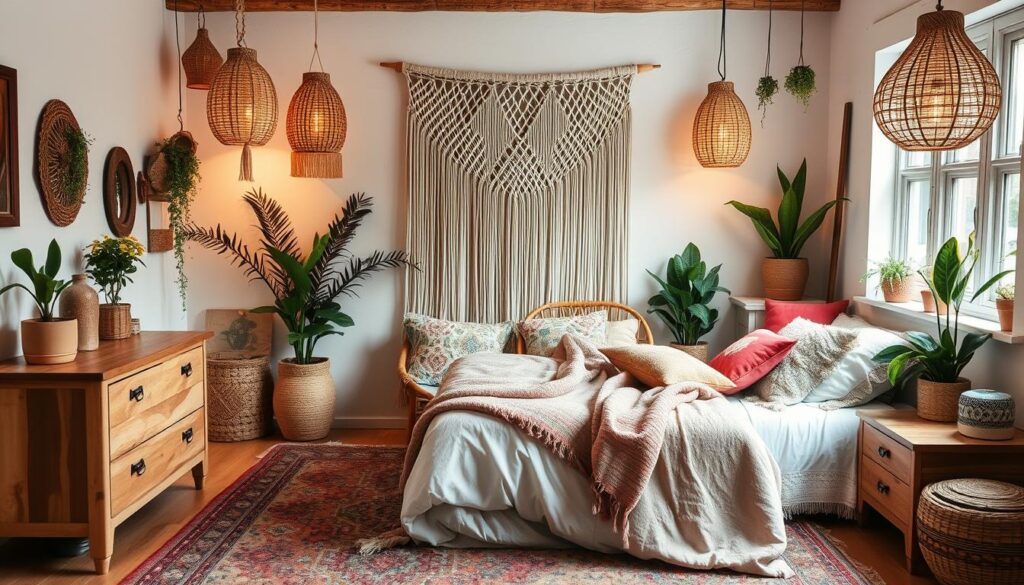
– Japandi + Boho — add a vintage woven vessel or a more heavily textured rug for extra tactility
– Japandi + Organic Modern — bring in plaster finishes and rounded, sculptural furniture forms
– Wabi-sabi + Scandinavian — lighten the wood tones, add more airy white, keep the handmade imperfection
The room that works isn’t the one that looks untouched. It’s the one where you can point to the lopsided bowl, the slightly worn throw, the table with one small dent, and say — yeah, that’s mine, I picked that.
New mom embracing the chaos and creativity! 💕 Sharing budget-friendly tips for cooking, DIY hacks, home decor, fashion, and making every moment stylish and affordable