You’ve heard about Mackinac Island.
The fudge shops, the Victorian architecture, the horses clip-clopping down traffic-free streets.
But here’s what most people wonder before they book: how do I actually get there?
The answer is simple but non-negotiable: you take a ferry to Mackinac Island.
And that’s where most travellers’ questions begin.
Which ferry company should I trust?
How long does the crossing take?
Will my family end up seasick on the water?
What happens to my car?
I get it.
The uncertainty can feel paralyzing, especially when you’re planning a holiday that costs real money.
But here’s the truth nobody tells you: the ferry journey itself is part of the experience.
It’s not some forgettable transport method you endure to reach your destination.
It’s actually when your holiday begins.
Why You Can’t Drive to Mackinac Island (And Why That’s a Feature, Not a Bug)
Mackinac Island sits in Lake Huron, roughly five miles from Michigan’s mainland.
That water barrier is intentional. The island has been car-free since 1898.
No vehicles. No noise pollution. No exhaust fumes.
This makes it genuinely unique in North America.
You can’t bridge it.
You can’t tunnel under it.
You can only reach it by water or small aircraft.
The ferry is how 99 percent of visitors arrive, and honestly, that’s exactly how it should be.
The journey across the Straits of Mackinac takes just 15 to 16 minutes.
That’s barely enough time to grab a coffee from the snack bar and find your seat on the upper deck.
But those 16 minutes matter.
They signal the shift from the modern world to something slower, something older, something better.
Your car stays safely parked on the mainland.
You leave behind rush hour anxiety, traffic jams, and the constant hum of engines.
What you carry onto that ferry is all you need.
The Ferry Companies Running the Route: Who You’re Actually Trusting With Your Trip
Three major ferry operators run the Straits of Mackinac.
Understanding each one matters because they shape your experience.
Shepler’s Mackinac Island Ferry has been family-owned since 1945.
That’s nearly 80 years of consistency.
They’re known for speed, reliability, and comfort.
Their boats are modern and well-maintained.
If you want a no-fuss, straightforward crossing, Shepler’s is the name you’ll hear recommended most often.
They operate seasonally from late April through October.
I took Shepler’s on my first visit to the island about five years ago.
What struck me wasn’t just the efficiency—though the staff moved hundreds of passengers through the dock in minutes—but the small details.
The upper deck had actual cushioned seating instead of hard benches.
A crew member cleaned the railings between departures.
The boat left exactly on schedule.
Those details sound minor until you’ve been on a ferry where nothing works quite right.
Arnold Transit Company brings history to the table.
They’ve been operating for over a century.
Their boats have character. Real wood, classic design, the kind of vessels that feel like you’re traveling back in time.
They’re also one of the few operators offering limited winter service, which matters if you’re planning an off-season escape.
Star Line Mackinac Island Ferry runs modern hydro-jet ferries alongside traditional boats.
They depart from both Mackinaw City (Lower Peninsula) and St. Ignace (Upper Peninsula).
That dual-location advantage is huge if you’re coming from Wisconsin or the Upper Peninsula.
The hydro-jet technology means faster, smoother crossings when water conditions cooperate.
Here’s what matters: all three are legitimate, safe, and professional.
Pick based on which departure point works for you.
Where You’re Leaving From: Mackinaw City or St. Ignace
Your departure point determines your entire logistics.
Mackinaw City sits in the Lower Peninsula, directly south of the Mackinac Bridge.
Most visitors to Michigan pass through here anyway.
If you’re coming from southern Michigan, Ohio, Indiana, or beyond, Mackinaw City is your natural choice.
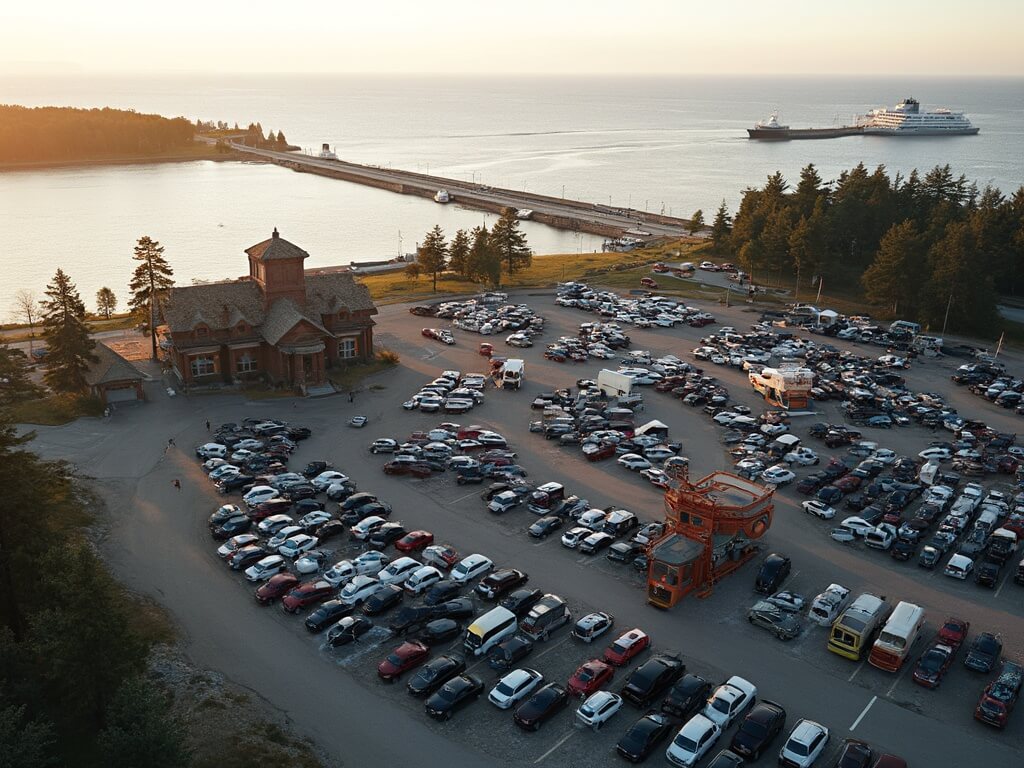
The dock has extensive parking, restaurants, gift shops, and clean facilities.
You won’t feel rushed or uncomfortable while you wait.
St. Ignace is in the Upper Peninsula, directly north of the Mackinac Bridge.
If you’re road-tripping from Wisconsin, Minnesota, or already exploring the UP, St. Ignace eliminates backtracking.
The crossing from St. Ignace is slightly longer than from Mackinaw City, but we’re talking minutes.
It’s negligible.
The decision is purely geographic.
Choose whichever dock is closest to where you’re coming from.
The Ferry Schedule: When Boats Leave and What to Expect
The ferry season runs from late April through the end of October.
This isn’t random timing.
Ice in the Straits makes winter crossings unreliable.
Spring and autumn weather is unpredictable.
Summer is prime season.
First ferries leave as early as 7:30 a.m.
Last departures vary: 8:00 p.m. in shoulder season, up to 10:00 p.m. during peak summer months.
During busy periods, boats leave every 30 minutes.
That frequency matters.
You don’t need reservations for standard service.
You just show up, buy a ticket, and board the next available ferry.
During July and August, “next available” might mean waiting 20 minutes max.
Some operators offer special event cruises too.
Narrated lighthouse tours that take 25 minutes instead of 16.
Fireworks cruises during holiday weekends.
These cost extra but add a different flavour to the crossing.
Want more lighthouse adventures? Check out our guide to take a lighthouse tour in Maine.
The Cost: What You’ll Actually Pay to Cross
Round-trip adult fares run between £26 and £34 (roughly $36–$48 USD).
Children aged 5 to 12 cost roughly £18–£25 ($24–$36 USD).
Kids under 4 travel free.
That’s per person, each direction.
A family of four—two adults, two kids—is looking at roughly £90–£120 ($120–£160 USD) round-trip.
It’s not free, but it’s reasonable for a full-day trip.
Here’s where it gets interesting: discounts exist.
Online booking often saves 10 percent.
Group rates apply for parties of 15 or more.
Senior discounts are standard.
Military discounts are available.
Most people don’t ask about these because they don’t know to ask.
You should ask.
You can buy tickets in advance online through the ferry operators’ websites.
This serves two purposes: you lock in your price and you skip the ticket line on departure day.
During peak summer weekends, that saved time is genuine relief.
Parking and What Happens to Your Car
Your vehicle stays on the mainland.
Both Mackinaw City and St. Ignace have extensive parking lots dedicated to ferry passengers.
Daily parking runs £18–£35 ($25–$50 USD) depending on the lot and season.
Overnight parking costs the same.
That’s not free, but it’s secure and convenient.
Many operators include a shuttle service from parking to the dock.
The lot attendants are used to directing visitors.
You park, take the shuttle, and your car sits safely until you return.
Some travellers worry about leaving their vehicle for an entire day or overnight.
The reality: ferry parking is secure, well-monitored, and uneventful.
Thousands of cars sit in these lots every summer.
Theft is rare.
Vehicle damage is rarer.
The bigger question is luggage.
If you’re staying overnight on the island, what do you do with your bags?
This is where the ferry operators earn their reputation.
Many hotels coordinate directly with the ferry companies.
You check your luggage at the dock.
It arrives in your hotel room before you do.
You walk off the ferry, explore Main Street, grab lunch, and by the time you reach your hotel, your bags are waiting in your room.
Some travellers handle luggage themselves.
You retrieve your bags from the dock and either carry them or hire a horse-drawn taxi (£2–£4, about $3–$5 USD per trip).
Either way works.
But the coordinated luggage service is one of those small miracles that makes the whole experience feel effortless.
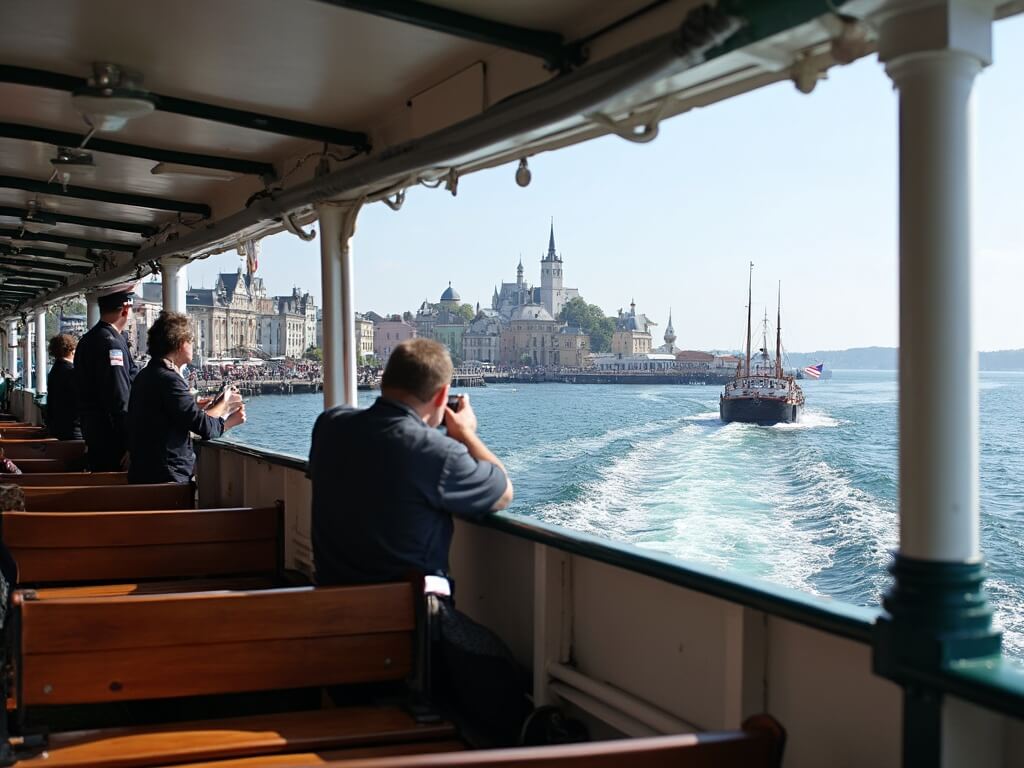
What the Ferry Ride Actually Feels Like
Here’s what you need to know about being on the water for 16 minutes.
The boats have multiple decks.
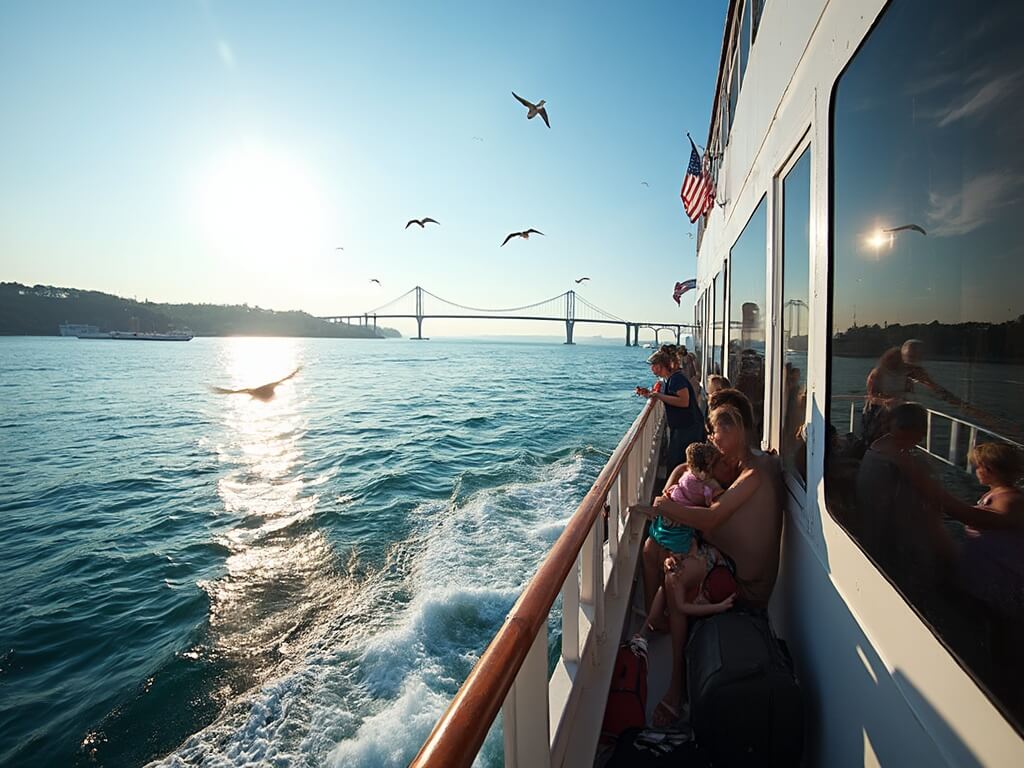
Upper decks are open air with panoramic views of Lake Huron and the Mackinac Bridge.
Lower decks are enclosed with comfortable seating and large windows.
Most people spend the crossing on the upper deck because the views are worth it.
The Straits of Mackinac can be choppy depending on season and weather.
Summer crossings in calm conditions are smooth.
Early or late season crossings can be rougher.
If you’re prone to seasickness, sit midship (middle of the boat) on the lower deck.
Motion is least noticeable there.
Avoid the front and back where you feel every wave.
The snack bar sells coffee, soft drinks, and light snacks.
Nothing fancy, but it’s there.
Most people stand on the upper deck and watch the water, the bridge, and the island growing larger.
The staff moves you on and off efficiently.
It’s orchestrated.
Hundreds of people board, sit, cross, and disembark without chaos.
It’s actually impressive once you notice it.
Pets are allowed if leashed.
A small pet ticket is required (roughly £3–£5, $4–$7 USD).
Bicycles travel too for an extra fee (about the same as pets).
You lock them on the lower deck and retrieve them on arrival.
The entire experience—parking, walking to the dock, boarding, crossing, disembarking—takes roughly 90 minutes to two hours from the moment you leave your car.
What Happens When Weather Gets Difficult
This is the reality nobody emphasizes enough: weather can disrupt ferry schedules.
Storms, dense fog, or rough water conditions can delay departures.
Early or late in the season, ice in the Straits can shut down service entirely.
If you’re visiting in May or October, build flexibility into your schedule.
Don’t book flights or connections that depend on a specific ferry departure.
Winter service is minimal and unreliable.
If you’re determined to visit November through April, you’re betting on weather cooperation.
Some years it works out.
Some years you’re stranded on the mainland.
The ferry operators are transparent about this.
They won’t send boats into genuinely dangerous conditions.
Your safety matters more than schedule precision.
Check the forecast before you go.
Call ahead if weather looks dicey.
Have a backup day if you’re visiting during shoulder season.
The vast majority of crossings happen exactly as scheduled.
But acknowledgement of risk is part of respect for being on the water.
The Real Experience Begins the Moment You Buy Your Ticket
Taking a ferry to Mackinac Island is straightforward logistically.
Pick a departure point, buy a ticket, show up at the dock, board the boat, and 16 minutes later you’re stepping onto an island where no cars exist and time moves differently.
The journey itself sets the tone for everything that follows.
As you pull away from the dock and watch the mainland recede, something shifts.
Your phone loses signal.
The noise of the modern world fades.
The water stretches out in front of you, and the island appears on the horizon.
That moment—when you realise you’re actually committed to leaving behind all the usual distractions—is when your real holiday starts.
For more American adventures, consider our guide on spend a day at Mall of America in Minnesota.
Arrival on Mackinac Island: The Moment Everything Changes
The ferry pulls into the dock on Mackinac Island’s southern shore. You’ve crossed the Straits in 16 minutes. Now comes the part that actually matters.
The boat is tied off. The gangway lowers. Hundreds of passengers begin moving toward Main Street.
The first thing you notice is the absence of engine noise. No car horns. No sirens in the distance. No low rumble of traffic. Just the sound of people talking, horse hooves on pavement, and the water lapping against the dock.

That silence is real. It stays with you.
The dock area is organized chaos in the best way. Ferry staff direct foot traffic toward luggage claim. Porters in striped vests stand ready to help with bags. Hotel representatives hold signs with guest names. Taxi drivers (all with horse-drawn carriages) wait near the exit.
If your hotel coordinated luggage delivery, you simply walk past the luggage area. Your bags are already being loaded onto a cart heading to your accommodation. You won’t see them again until you reach your room.
If you’re handling your own luggage, the process is straightforward. Retrieve your bags, either carry them yourself or flag down a taxi. The ride to most Main Street hotels costs £2–£4 ($3–$5 USD). It takes maybe five minutes.
Here’s what’s remarkable: within ten minutes of stepping off the ferry, you’re standing on Main Street surrounded by Victorian storefronts, the smell of fudge drifting from a dozen shops, and the absolute certainty that you’ve left the regular world behind.
No cars. No traffic lights. No delivery trucks. Just people, horses, bicycles, and the simple rhythm of a place that stopped evolving in the 1890s and decided it was perfect.
Getting Around: Your Actual Options on a Car-Free Island
Walking is the primary way to move around Mackinac Island. The downtown core—where most shops, restaurants, and hotels cluster—is compact enough to traverse in 15 minutes on foot.
But you have other options if walking doesn’t work for you.
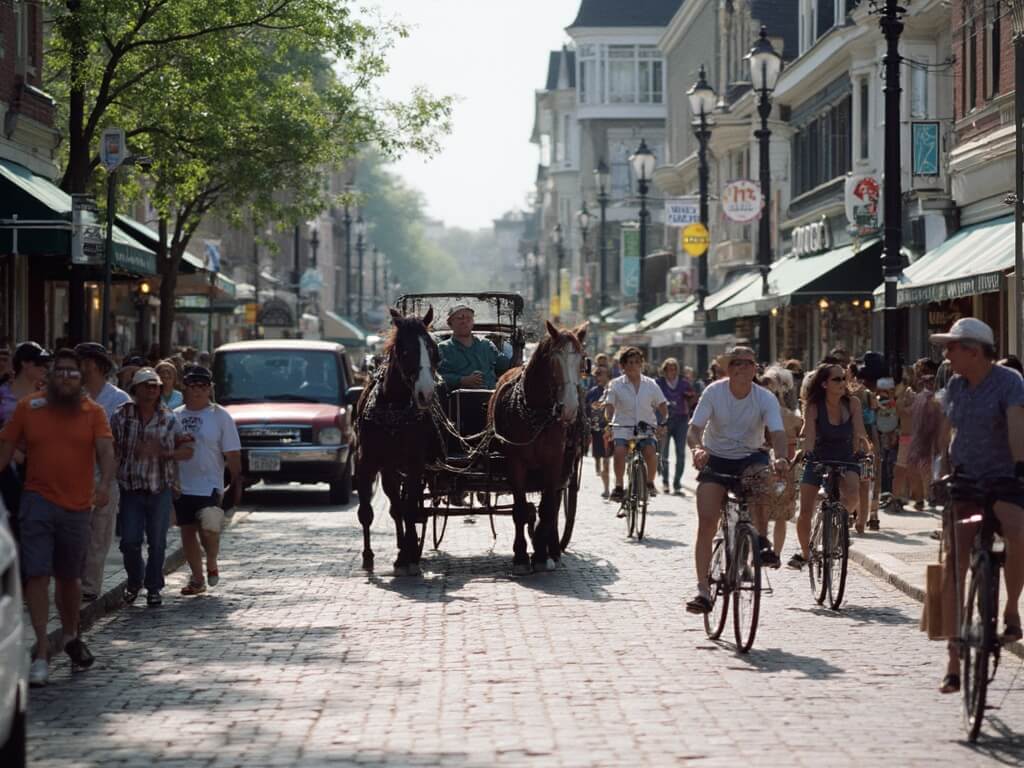
Bicycles are everywhere. Rental shops line Main Street. A day rental runs roughly £10–£15 ($13–$20 USD). If you brought your bike on the ferry, you’ve already paid the extra fee at departure. Either way, cycling is fast, fun, and genuinely the best way to explore the island’s quieter neighborhoods and the shoreline paths.
Horse-drawn taxis are the iconic image of Mackinac Island for a reason. These aren’t quaint tourist traps. They’re legitimate transportation. A ride costs £3–£5 ($4–$7 USD) per trip depending on distance. For a full-day island tour, expect to pay £50–£75 ($65–$100 USD).
The horses are well-cared-for. There are strict regulations about work hours and conditions. And honestly, watching a horse navigate the crowded streets with the same ease a car navigates a highway is genuinely impressive.
Walking with a map is free and forces you to get lost in the best way. You discover shops you didn’t know existed. You stumble onto quiet residential streets where locals actually live. You find viewpoints over the water that aren’t in any guidebook.
Most visitors combine all three throughout their stay. Walk Main Street in the morning, rent a bike to explore the eastern shore in the afternoon, take a taxi to Fort Mackinac at sunset.
The island is small enough that no single trip takes more than 30 minutes.
Looking for more tips on where to catch the ferry to Mackinac Island? This guide has you covered.
Weather, Timing, and Why Planning Ahead Matters
Here’s the hard truth that ruins some people’s holidays: Mackinac Island is subject to Lake Huron weather.
Lake Huron is the second-largest Great Lake. It’s cold, deep, and produces weather systems that come up fast.
Summer visits between mid-June and early September are nearly guaranteed to work. The water is calm. The ferries run on schedule. The weather is warm. This is peak season for a reason.
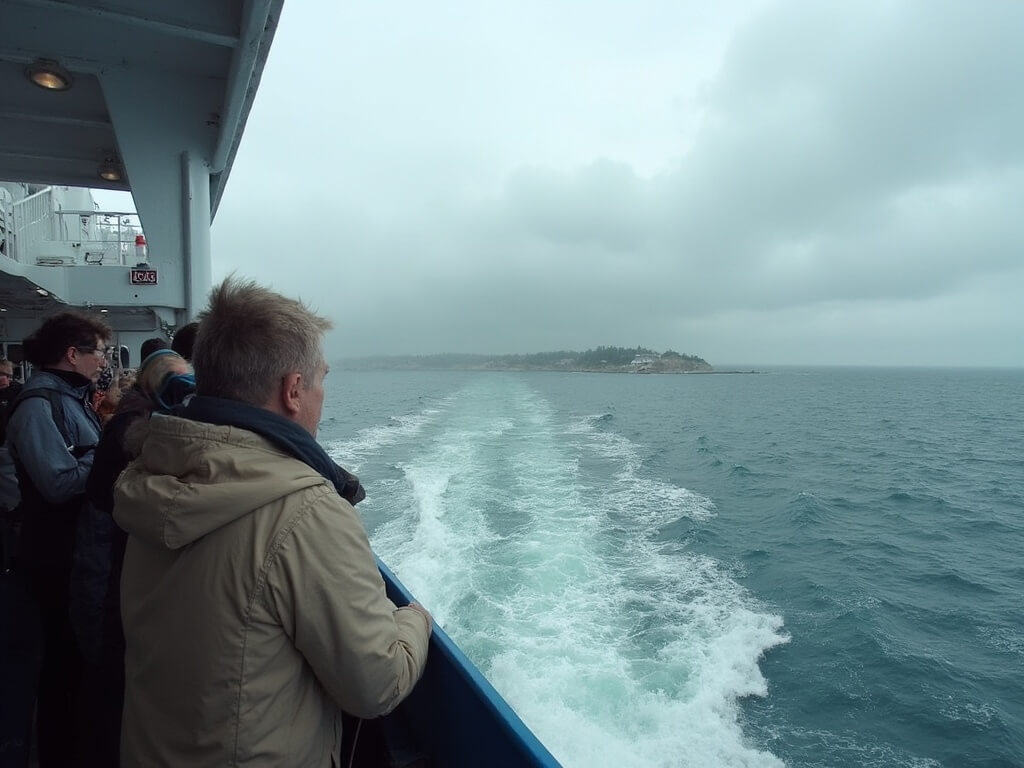
But if you’re visiting in May, October, or any shoulder season month, you’re gambling.
I learned this the hard way on my third visit to the island…
The lesson: don’t book tight connections around ferry departures during shoulder season. Build buffer time. Have flexibility.
To ensure a smooth trip, check the Planning Your Trip to Mackinac Island page for updates.
What to Pack: The Details That Prevent Regret
The Straits of Mackinac has its own microclimate.
- Bring a light jacket even if the forecast says 75 degrees (24°C).
- Wear comfortable shoes—Main Street is cobblestone and uneven.
- Pack sunscreen even if it’s cloudy. Water reflects UV rays.
- Bring cash along with your card—some vendors are cash only.
- Don’t overpack—you’ll carry your luggage at some point.
- Carry prescription medications in a day bag in case of delays.
Special Circumstances: Pets, Groups, and Private Charters
Taking your dog to Mackinac Island is absolutely possible.
Leashed pets are allowed on ferries. The island is dog-friendly. Many hotels accommodate pets. Just keep summer heat in mind.
Groups of 15+ people get discounts. Contact ferry operators directly. You can even arrange private charters for events.
The Hidden Costs Nobody Mentions (But Should)
- Parking: £25–£50 ($33–$65 USD) per day.
- Luggage delivery: up to £20 ($26 USD) per bag.
- Daily transportation: estimate £30–£50 ($40–$65 USD).
- Dining: 20–30% more expensive than mainland.
- Attractions: Fort Mackinac £15 ($20 USD), carriage tours up to £75 ($100 USD).
- Fudge: Everyone buys it—budget £20–£50 ($25–$65 USD).
Accessibility and Special Needs: Questions You Should Ask Before Booking
Ferries accommodate wheelchairs and mobility devices. Staff assist with boarding. But the island presents physical challenges—cobblestones, inclines, narrow sidewalks.
Call ahead to hotels. Discuss room accessibility. Ask about elevator access and bathroom setup.
Service animals travel free. Standard pet ticket does not apply.
When to Visit: The Strategic Timing Question
- July & August: peak season, crowded, reliable weather.
- June & early September: ideal balance, fewer crowds.
- May & October: quiet, cheaper, but weather is a gamble.
- Winter: unpredictable ferry service, most places closed.
Addressing Common Fears and Misconceptions
- Seasickness? Rare on 16-minute crossings.
- Missed return ferry? Plan buffer days and get travel insurance.
- Parking safety? Monitored lots. Unattended cars are safe.
- Alcohol? Allowed in small quantities. No open containers.
- Reservations? Not required but recommended in summer.
The Sustainable Travel Angle: Why Ferry Access Matters
Mackinac Island’s car-free policy is intentional and environmentally conscious. It preserves the island’s charm and reduces emissions.
Modern ferries use less fuel and some explore biodiesel. Choosing the ferry supports sustainable travel and keeps Mackinac Island special.
Your Pre-Ferry Checklist: The Details That Prevent Day-Of Stress
- 2 weeks prior: Book ferry, reserve hotel, start checking forecast.
- 1 week prior: Confirm hotel and luggage details.
- 3 days prior: Check forecast and ferry status.
- Day before: Pack, check schedules and traffic.
- Morning of: Arrive early, bring jacket and ID.
The Ferry Experience as Part of the Memory
The ferry isn’t just transportation. It’s transition.
You remember the lake air. The sound of the engine slowing. The first clop of hooves. The smell of fudge. The moment you knew: this place is different.
Making Your Decision: Should You Actually Do This?
Yes. If you want quiet, charm, and an experience unlike anywhere else in North America, take the ferry to Mackinac Island.
It’s easy to plan, short to cross, and long to forget.
Need more travel inspiration? Check out these experiences:
- Visit the National Civil Rights Museum in Memphis
- Hike to Delicate Arch in Arches National Park
- Walk the Beaches of the Oregon Coast
- Explore White Sands National Park
- Drive the Hana Highway in Maui
Get started by visiting Planning Your Trip to Mackinac Island.
Then step onto that ferry. Let 16 minutes change how you think about travel.