Image Credit @Just Travelous
You’ve probably heard whispers about Carhenge.
That weird Nebraska roadside attraction made of old cars arranged like Stonehenge.
Maybe you’ve seen the photos.
Maybe you’ve wondered if it’s actually worth the drive.
But here’s what most people miss: Carhenge isn’t just a quirky photo op.
It’s one of the best places in America to experience total darkness during a solar eclipse, and the dark skies there are spectacular enough to pull serious astronomers from across the country.
The problem is, most visitors show up unprepared.
They don’t know how to maximise the experience.
They get caught in the crowds without proper eyewear.
They miss the whole point of why this place matters.
That’s what we’re fixing today.
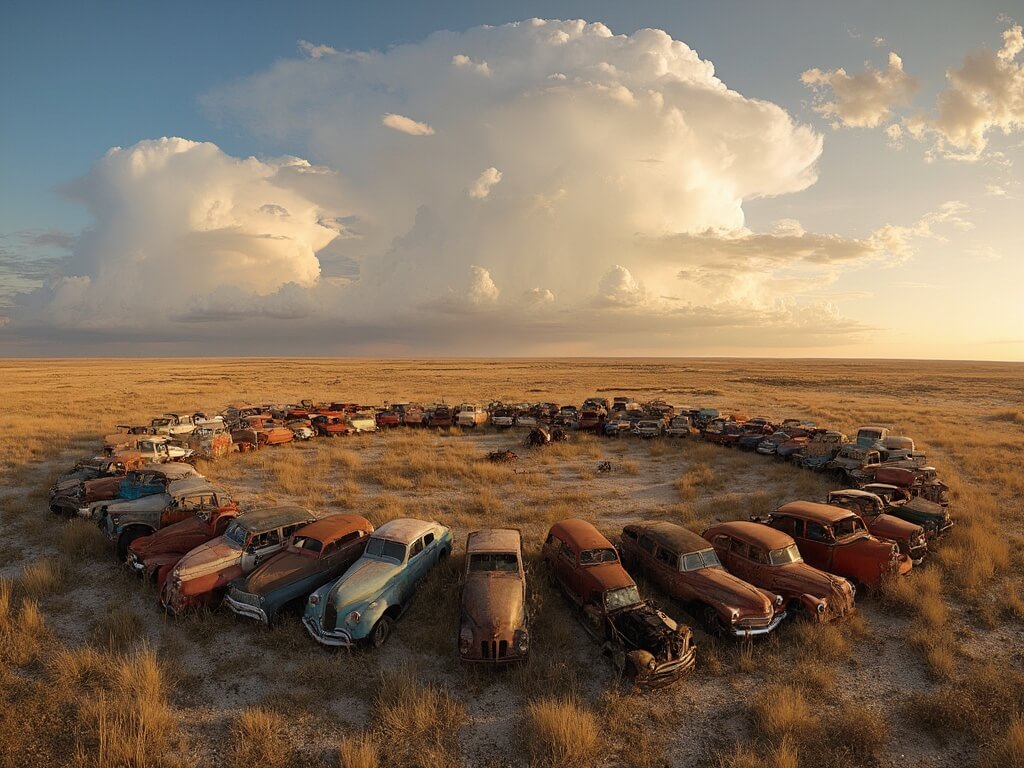
Image Credit @Just Travelous
What Exactly Is Carhenge and Why Should You Care About Watching Total Darkness There?
Carhenge isn’t an accident.
It’s deliberate art.
In 1987, a man named Jim Reinders took 25 vintage cars from the 1950s and 1970s—rusted Cadillacs, Studebakers, and other American relics—and arranged them in a perfect circle 29 metres in diameter on the high plains of Nebraska.
The structure mirrors Stonehenge almost exactly, except instead of stone, you get chrome and steel weathered by prairie winds.
Here’s why this matters for watching total darkness: Carhenge sits on US Highway 385, just three miles north of Alliance, Nebraska.
It’s in the middle of nowhere, which is precisely the point.
No city lights.
No light pollution masking the sky.
Just open plains and genuine darkness when the sun disappears.
The attraction opened to the public and locals hated it initially.
They thought it was vandalism, a waste of good cars, an embarrassment.
Today, it’s listed on the National Historic Register and generates serious tourism revenue for the surrounding community.
It’s also permanently open—24 hours a day, 365 days a year, with free admission.
The gift shop runs seasonally, but you can walk the grounds anytime.
The 2017 Eclipse: When 10,000 People Gathered to Watch Darkness Fall
I remember reading the first reports about the 2017 total solar eclipse path.
When I saw that Carhenge sat directly in the path of totality—meaning it would experience a full two minutes and thirty seconds of complete daylight darkness—I knew something special was about to happen.
The predictions were right.
Between 4,000 and 10,000 people descended on Carhenge for the August eclipse.
The locals weren’t prepared for it, but they handled it with remarkable grace.
I spoke with a woman who’d driven from Colorado specifically for the event, and she described the atmosphere as electric but orderly.
Families with kids.
Serious amateur astronomers with telescopes the size of small children.
One bloke wearing a tinfoil hat for reasons nobody quite understood.
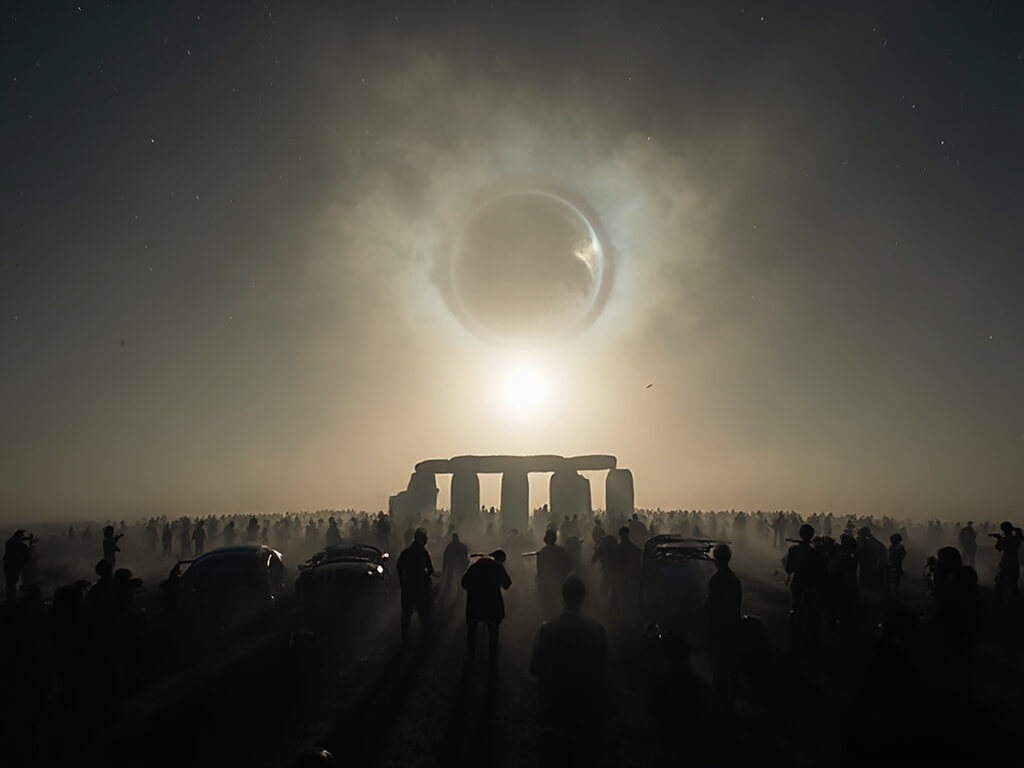
Image Credit @Just Travelous
Everyone was there for the same reason: to experience totality.
What made the 2017 event at Carhenge genuinely special was the marriage of art and astronomy.
As the moon slowly crept across the sun, the vintage cars transformed.
Silhouettes deepened.
The landscape became otherworldly.
You weren’t just watching an eclipse—you were experiencing it through a lens of cultural art and human creativity.
The eclipse itself delivered the goods.
The path of totality meant Carhenge experienced complete darkness for two minutes and thirty seconds—long enough to see stars in the daytime, long enough for the temperature to drop noticeably, long enough to feel something genuinely primal about being part of a celestial dance.
Photographers captured the moment from every angle.
360-degree videos showed crowds gasping as the corona flared into view.
Time-lapse footage documented the eerie transition as day became night became day again.
That single event transformed how people viewed Carhenge.
It wasn’t just a novelty anymore.
It was a destination.
Why the Darkness at Carhenge Is Different From Most Other Places
Here’s the crucial bit: not all dark skies are created equal.
Alliance sits in Nebraska’s Sandhills region.
The area has minimal light pollution compared to virtually any populated region in America.
The nearest significant city is North Platte, which is 60 kilometres away.
Smaller towns dot the landscape, but they’re sparse enough that their light doesn’t significantly compromise the night sky.
This matters enormously when you’re trying to observe astronomical phenomena.
Light pollution doesn’t just ruin stargazing—it fundamentally changes what you can see.
In cities, you might spot the brightest constellations and perhaps the moon if you’re lucky.
At Carhenge, the Milky Way appears so vividly that people unfamiliar with night sky observing often gasp the first time they see it.
The band of light stretching across the sky seems impossible until you realise it’s actually real.
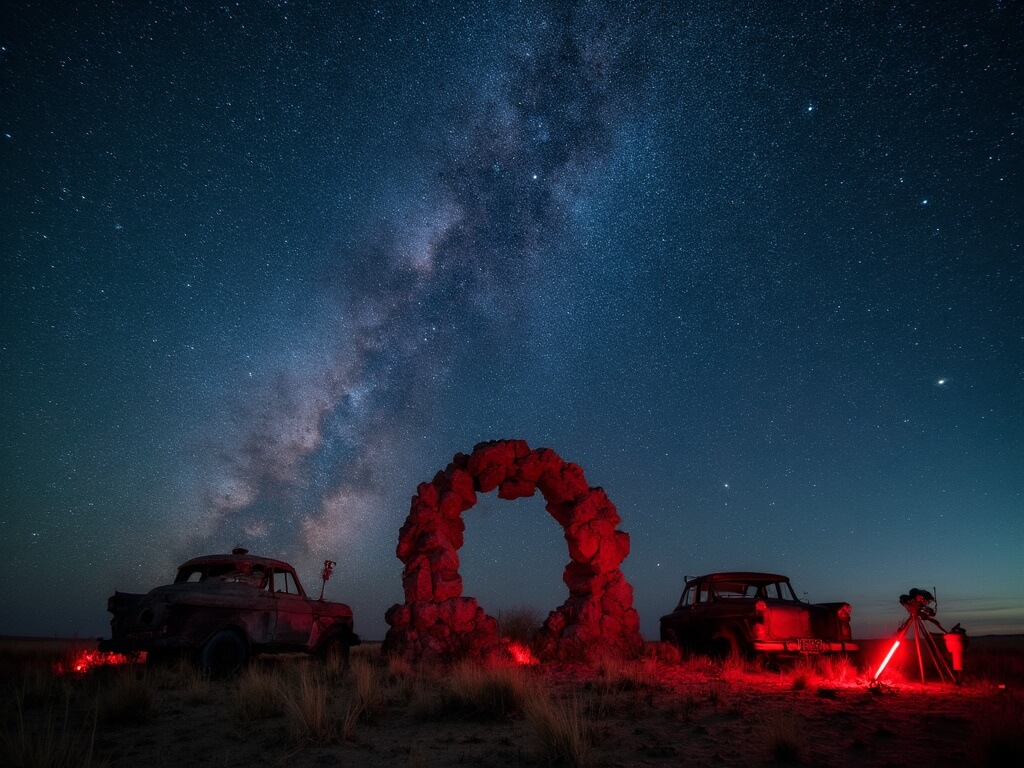
Image Credit @Just Travelous
I experienced this myself a few years back during a stargazing trip to rural Wyoming.
I’d lived in cities most of my life, and I genuinely didn’t understand why people got so worked up about the night sky.
The first time I saw the Milky Way in proper darkness, with zero light pollution interference, I sat on the ground for forty-five minutes just staring upward.
It’s a different experience entirely.
It changes your perspective on what’s actually above you every single night.
The landscape itself enhances the experience.
Carhenge’s cars create dramatic silhouettes against the sky.
During twilight, they frame constellations and planets.
During an eclipse, they frame the corona.
If you’re photographing the Milky Way, you’ve got this incredible artistic element in the foreground.
It’s not just about what’s in the sky—it’s about what’s happening on the ground below it.
The Infrastructure That Makes Carhenge Functional for Eclipse Events
You might think watching total darkness at Carhenge means roughing it in the middle of nowhere.
Partially true, but the reality is more nuanced.
The site itself is minimal but functional.
There’s a seasonal gift shop that operates during peak tourism periods, particularly around major astronomical events.
Educational panels explain the history of both Carhenge and the broader art installation.
Basic park facilities exist, though expectations should remain realistic—this is still rural Nebraska, not Disneyland.
The real infrastructure advantage comes from the surrounding community.
Alliance, the nearest town, has transformed into an astronomy tourism hub over the past decade.
The Knight Museum offers genuine historical context about the region.
The Sandhills Center provides cultural programming.
Even the local military museum attracts visitors seeking to understand Nebraska’s broader history.
Accommodation options range from basic motels to bed-and-breakfasts.
Restaurants serve everything from standard Americana to surprisingly decent independent joints.
Shops sell eclipse glasses, snacks, and supplies.
During major events, the community mobilises volunteer support.
Information kiosks appear.
Staff presence increases.
Local people go genuinely out of their way to make visitors feel welcome.
This grassroots hospitality isn’t corporate—it’s authentic community engagement.
The folks in Alliance understand that Carhenge brings tourism dollars, but they also seem to genuinely care about sharing something meaningful.
What Makes the Dark Skies Worth Your Time Beyond Just Eclipses
Here’s where most travel guides miss the actual story.
Eclipses are rare, spectacular, and absolutely worth planning around.
But they’re also temporary.
An eclipse happens for a few minutes.
Then it’s over.
What about the other 364 days of the year?
Nebraska’s Sandhills region remains one of America’s best-kept secrets for dark sky experiences.
The entire area qualifies as a genuine dark sky destination.
If you’re seriously into stargazing, Nebraska offers something most other states can’t: vast expanses with minimal light pollution, accessible locations, and an emerging amateur astronomy community.
The Nebraska Star Party at Merritt Reservoir, situated roughly 200 kilometres from Carhenge, holds official designation as an International Dark Sky Association Dark Sky Place.
This isn’t casual designation—it requires rigorous measurement, ongoing monitoring, and commitment to maintaining darkness standards.
The event attracts amateur astronomers from across the region.
They bring serious equipment.
They share knowledge.
Activities range from beginner-friendly telescope introductions to advanced deep-sky object hunting.
Toadstool Geological Park, another nearby location, combines daytime geological interest with evening star-viewing opportunities.
You get the unique formations during daylight, then stick around as dusk falls and the sky transforms.
These aren’t separate experiences from Carhenge—they’re part of a broader dark sky ecosystem emerging across Nebraska.
The Practical Reality of What You Actually See When Total Darkness Falls
Let’s be direct about what happens during totality at Carhenge.
The eclipse begins as a gradual nibble from the sun’s edge.
If you’re not wearing proper eclipse glasses—and you absolutely must—you’ll miss it because it’s not that visually interesting at first.
This takes roughly an hour and a half before reaching totality.
Then, in the final minute before totality, things change rapidly.
The light quality becomes bizarre.
It’s not quite darkness, not quite twilight.
Everything takes on an otherworldly pale grey tone.
Shadows sharpen and distort.
The temperature drops noticeably—often 10 to 15 degrees Celsius in under a minute.
The moment totality hits, it’s darkness.
Genuine midday darkness.
Stars appear overhead.
You can see Venus and other bright planets in the daytime.
The sun’s corona—the white tendrils of plasma normally invisible—blazes around the moon’s silhouette.
It looks absolutely unreal.
Photographs don’t capture it properly.
Video doesn’t capture it properly.
You have to be there.
The entire experience lasts about two minutes and thirty seconds at Carhenge.
It sounds short until you’re experiencing it.
Then it somehow feels both instantaneous and eternal.
The darkness recedes as quickly as it arrived, and normal daylight returns.
Your eyes adjust back to regular daytime brightness within seconds.
People cheer, applaud, occasionally cry.
It’s genuinely primal.
Beyond eclipses, when you’re simply stargazing at Carhenge, the darkness enables you to see things you’ve never noticed before.
The Essential Gear You Actually Need (Not Just Tourist Nonsense)
For eclipse viewing specifically:
- Certified ISO 12312-2 eclipse glasses (non-negotiable—viewing the sun without them causes permanent eye damage)
- Backup glasses (bring extras for anyone without their own)
- If you’re photographing: solar filters for your camera lens and a neutral density filter for video
For general stargazing:
- Binoculars (surprisingly effective and often underrated by casual observers)
- A telescope if you own one (Carhenge attracts experienced amateur astronomers with significant equipment)
- Red headlamp or red flashlight (preserves your night vision instead of destroying it with bright white light)
For comfort:
- Warm clothing (desert nights get cold, even in summer)
- Blanket or mat for lying on your back while observing
- Water and snacks
- Mosquito repellent (Nebraska plains can have decent mosquito populations)
- Sunscreen (even during eclipse events, the un-eclipsed portions of the sun are strong)
For photography:
- Tripod (essential for any serious night sky photography)
- Wide-angle lens (captures more sky)
- Manual focus capability (autofocus fails in darkness)
- Extra batteries and memory cards (they drain faster in cold conditions)
Leave the fluff at home.
You don’t need fancy gear to experience the darkness.
You need practical equipment that actually serves a purpose.
Why Crowds Actually Matter (And How to Handle Them)
During major celestial events, Carhenge gets busy.
The 2017 eclipse drew between 4,000 and 10,000 people.
That’s significant for a rural attraction three miles outside a town of about 8,500 people.
The crowds create both opportunities and challenges.
The challenges are obvious:
- Parking becomes logistically complicated
- Traffic backs up significantly before and after the event
- Bathroom facilities become strained
- The site becomes visibly crowded
- Weather delays create unpredictable crowd surges
But here’s what most people miss: the crowds actually enhance the experience.
Yes, sounds counterintuitive.
But eclipses are inherently social events.
The collective experience of watching darkness fall during the day creates shared excitement that’s genuinely part of the appeal.
Strangers talk to each other.
Families bond.
The sense of being part of something larger than yourself intensifies.
I spoke with someone who’d attended the 2017 eclipse at Carhenge, and despite complaining about the crowds, they mentioned the emotional impact of experiencing totality surrounded by thousands of other people all feeling the same awe simultaneously.
To handle the crowds effectively:
- Arrive early—plan for significantly earlier arrival than you think necessary
- Be flexible about your exact viewing spot (Carhenge itself gets busy, but surrounding areas offer excellent views)
- Pack patience as earnestly as you pack your eclipse glasses
- Expect traffic delays both before and after—don’t plan time-sensitive activities immediately afterward
- Consider visiting during non-eclipse dark sky events to experience Carhenge without massive crowds
The darkness doesn’t require crowds to be meaningful, but crowds during major events don’t diminish the darkness either.
The real infrastructure advantage at Carhenge isn’t fancy facilities—it’s the combination of excellent viewing conditions, authentic community support, and something genuinely worth gathering to witness.
Planning another unique American adventure? You might also enjoy spending a day at Mall of America in Minnesota or learning history at the National Civil Rights Museum in Memphis.
When Weather Becomes Your Biggest Enemy (And How to Actually Prepare)
Here’s the uncomfortable truth about Nebraska in August.
Weather is unpredictable.
The Great Plains don’t follow scripts.
You can have clear skies one moment and thunderstorms rolling in the next.
I learned this the hard way during a stargazing trip to Wyoming—I’d driven eight hours, the forecast showed clear skies, and then a freak storm system moved in two hours before my planned observation window.
Everything was ready.
The telescope was mounted.
The location was perfect.
The weather had other ideas.
For eclipse events specifically, weather becomes existential.
You can’t reschedule a solar eclipse.
It happens on a specific day.
If clouds roll in over Carhenge at the precise moment of totality, you’re watching clouds, not the corona.
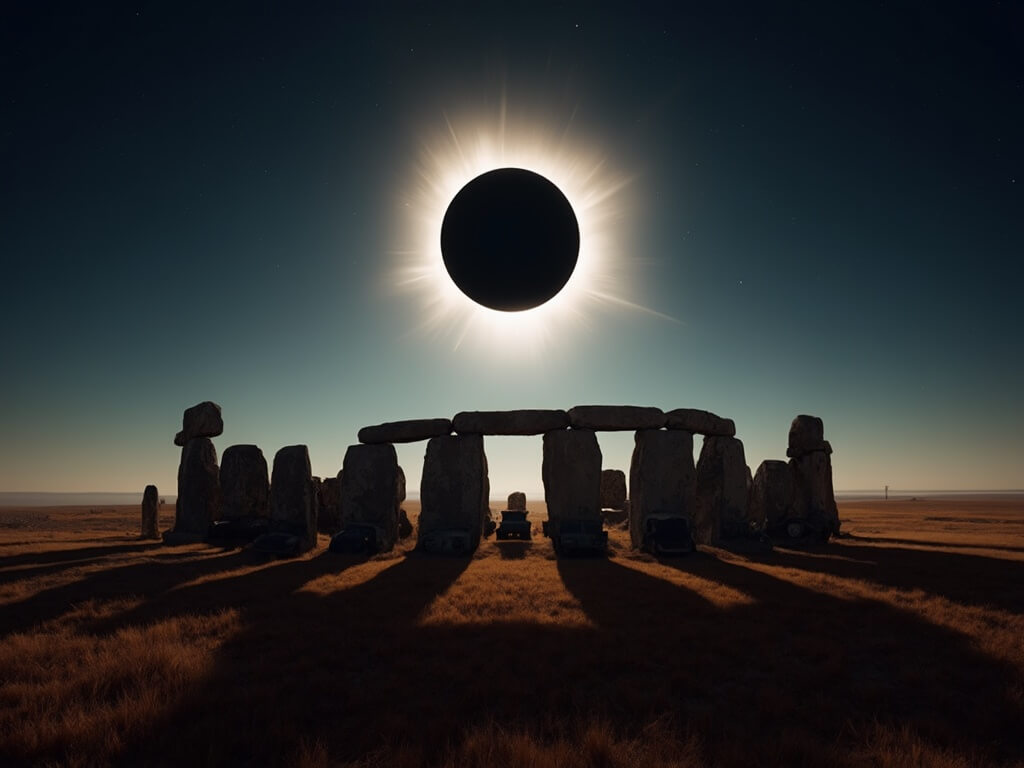
Image Credit @Just Travelous
This is why location flexibility matters.
The path of totality during the 2017 eclipse stretched across an entire swathe of the United States.
Smart observers didn’t commit exclusively to one location.
They scouted multiple viewing sites across the path and made final decisions based on weather forecasts in the 24 to 48 hours before the event.
Some people drove 400 kilometres that morning based on clearing cloud patterns.
For Carhenge specifically, keeping an eye on forecast models matters.
Nebraska’s Sandhills typically experience clearer skies than surrounding areas during summer, but that’s not guaranteed.
The National Weather Service provides increasingly detailed forecasts as eclipse day approaches.
Follow the trend—you’re not looking for perfection weeks out, you’re looking for patterns emerging in the final days.
What actually works for weather contingency planning:
- Monitor forecasts starting one week before the event
- Identify backup viewing locations within the path of totality (150 to 200 kilometres away)
- Follow local weather communities and amateur astronomer groups who track conditions specifically for eclipse events
- Have a flexible travel schedule allowing last-minute route changes
- Consider visiting Carhenge during non-eclipse dark sky events where clouds aren’t catastrophic—just disappointing
The darkness at Carhenge is magnificent precisely because conditions align perfectly.
But alignment isn’t guaranteed.
Prepare accordingly, and you’ll still have a remarkable experience even if the sky doesn’t fully cooperate.
What Accessibility Actually Looks Like at Carhenge
Too many travel guides gloss over accessibility.
They mention “family-friendly” without explaining what that actually means.
Carhenge is genuinely accessible for most people, but with realistic limitations.
The site is outdoors on relatively flat terrain.
The main circle is approximately 29 metres in diameter, so you’re walking around cars arranged in a large loop.
Paths are unpaved—mostly dirt and grass—so wheelchair accessibility is limited but possible if conditions are dry.
The nearest parking is very close to the site itself.
For visitors with mobility limitations, you can drive right up to the perimeter and view the entire installation without walking more than a few metres.
The car arrangement means you can see multiple angles from the parking area without extensive walking.
It’s not a perfect setup, but it’s workable.
For children, Carhenge works surprisingly well.
The novelty of cars stacked upright captures imagination immediately.
The scale is impressive without being intimidating.
Running around the circle keeps kids occupied without requiring specialized activities.
During eclipse events, the community mobilises with designated family areas and volunteer support.
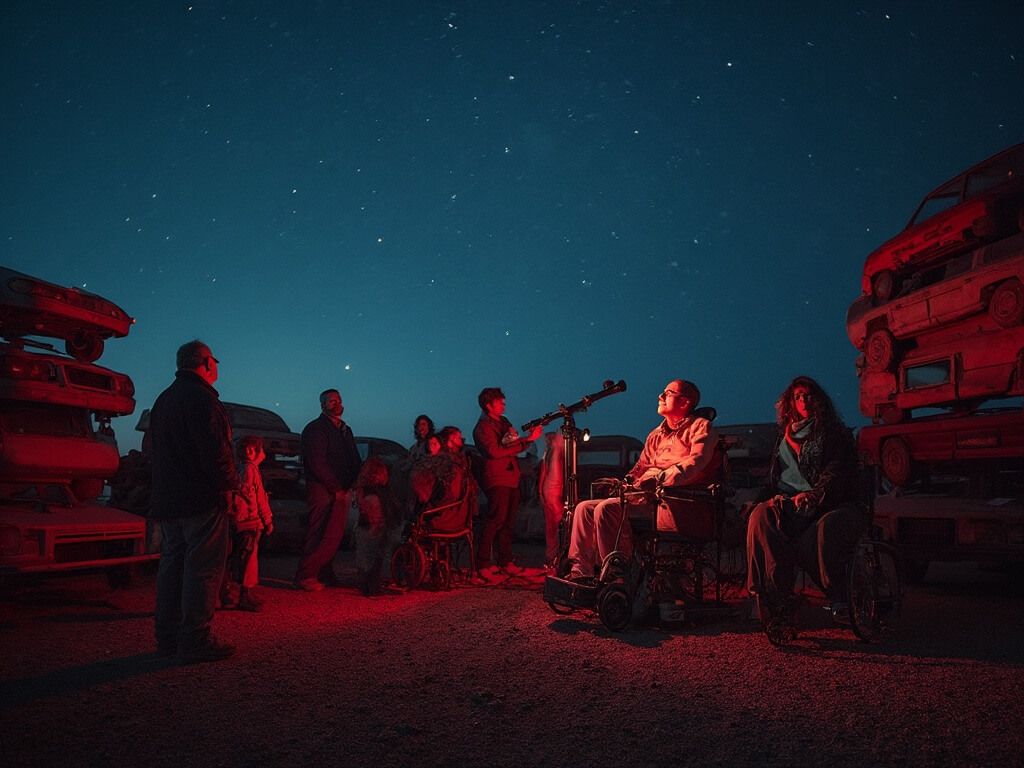
Image Credit @Just Travelous
The gift shop operates seasonally and staff can answer questions about accessibility specifics.
Call ahead before visiting if you have particular accessibility needs—the Alliance Chamber of Commerce connects you with staff who can provide detailed information.
What Carhenge doesn’t have:
- Extensive restroom facilities (porta-potties during major events)
- Shade structures for hot weather
- Permanent food services
- Wheelchair-accessible paved paths
What you need to know:
- Bring your own water and snacks
- Plan for sun exposure during daytime visits
- Expect basic facilities during eclipse events
- The experience doesn’t require accessibility infrastructure to be meaningful—the darkness itself is equally accessible to everyone
The Economic Impact Nobody Talks About (And Why It Matters)
When 10,000 people descended on Alliance for the 2017 eclipse, the local economy experienced something genuinely transformative.
Hotels sold out.
Restaurants served customers for consecutive hours.
Gas stations ran low on fuel.
Local businesses that normally operated on razor-thin margins suddenly experienced revenue surges.
The Alliance Chamber of Commerce published reports estimating several million dollars in direct economic impact from that single event.
Multiply that across multiple eclipse events, plus regular dark sky tourism, and you’re looking at meaningful income for a rural community that historically depends on agriculture and ranching.
This isn’t trivial.
Rural Nebraska communities face genuine economic pressure.
Young people move to cities.
Main streets struggle.
Tourism provides alternative revenue without requiring fundamental economic restructuring.
For Carhenge specifically, the economic benefit extends beyond direct eclipse events.
The Friends of Carhenge organisation maintains the site and coordinates seasonal displays.
Regular visitors generate ongoing business for local establishments.
The Carhenge brand has become recognisable enough that it draws tourists who might otherwise bypass rural Nebraska entirely.
What’s genuinely interesting is how this economic activity feeds back into preservation efforts.
As Carhenge’s cultural value increased, stewardship improved.
The National Historic Register listing formalized its significance.
Local investment in maintaining the installation increased.
Seasonal displays and art programming emerged.
Why Your Photography Approach Completely Changes in Total Darkness
Most people underestimate how differently photography works during eclipse totality.
Your camera doesn’t behave normally.
Autofocus fails because darkness confuses the focusing mechanism.
Automatic exposure settings become useless because the light level drops from daylight to twilight in seconds.
ISO requirements jump to levels that produce grainy images.
Everything you know about daytime photography becomes irrelevant.
During the partial eclipse phase, normal photography rules mostly apply.
You need strong neutral density filters and solar filters on your lens, but the fundamental principles remain constant.
Then totality hits, and everything inverts.
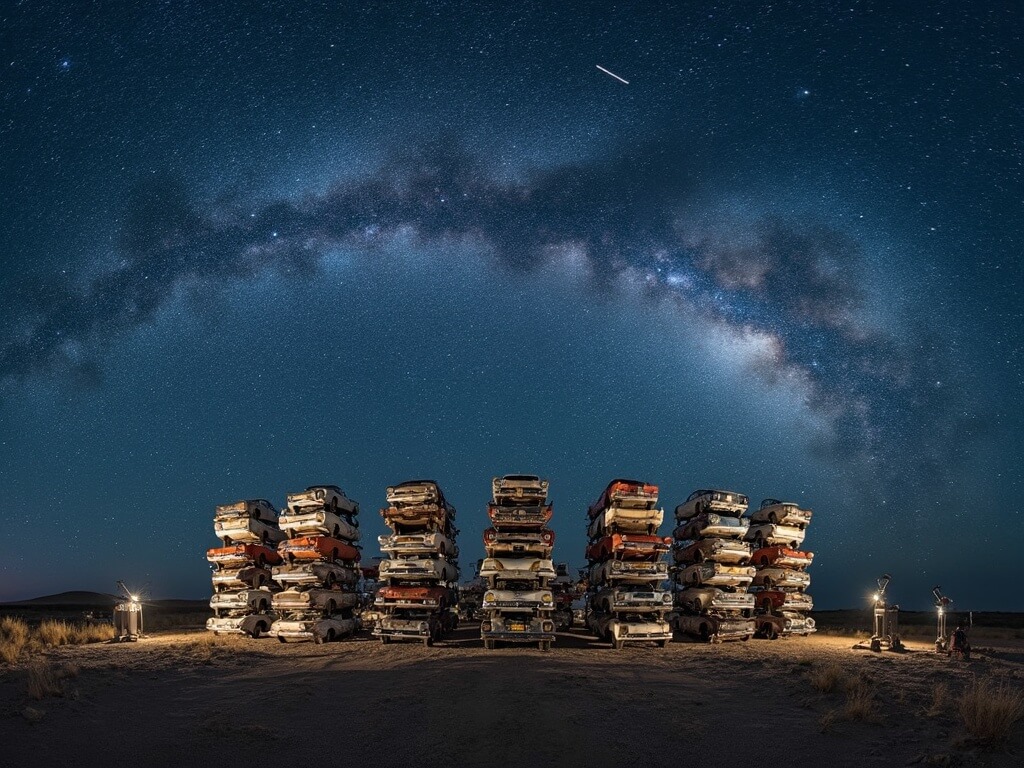
Image Credit @Just Travelous
The corona becomes visible with proper exposure settings.
You can see the shadow bands—mysterious rippling patterns that sweep across the ground as the moon blocks most of the sun’s light.
Stars become visible in the daytime sky.
The landscape transforms into an eerie twilight.
Here’s what actually works for eclipse photography at Carhenge:
- Start practicing manual mode settings well before the event
- Use online eclipse photography guides specific to your camera model
- Bring printed reference cards with recommended settings (you won’t remember them during the excitement)
- Test your equipment’s manual focus capabilities before the event
- Accept that your first eclipse photos will be mediocre—even experienced photographers struggle with eclipse totality
- Consider simply watching with your eyes rather than obsessing over capturing it—your memory will outlast any photo anyway
The Network of Dark Sky Destinations That Extend Your Journey
Carhenge exists within an emerging ecosystem of certified dark sky locations across Nebraska.
If you’re driving to Carhenge specifically for astronomical purposes, you’ve already invested travel time.
The surrounding region offers multiple experiences worth incorporating into your trip.
The Nebraska Star Party at Merritt Reservoir, roughly 200 kilometres northeast of Carhenge, holds International Dark Sky Association certification as a legitimate dark sky place.
The event typically occurs during late summer and attracts serious amateur astronomers.
I visited Merritt Reservoir a few years back during a dark sky observation trip, and the gathering impressed me immediately.
People brought elaborate equipment—massive telescopes, spectroscopy equipment, imaging setups that cost thousands of dollars.
But the community welcomed casual observers equally.
Multiple experienced astronomers offered telescope access and explanations.
Talks covered topics ranging from deep-sky object hunting to planetary observation to astrophotography.
The atmosphere balanced serious amateur astronomy with genuine inclusivity.
Other Nebraska attractions worth incorporating:
- The Knight Museum in Alliance for genuine regional history
- The Sandhills Center for cultural programming related to the region
- Various state parks offering both daytime activities and evening dark sky viewing
The Accessibility of Stargazing Equipment and What Actually Works
Here’s where people overthink astronomical observation.
You don’t need expensive equipment to see remarkable things in the Nebraska night sky.
Your naked eyes alone reveal the Milky Way in ways impossible from urban areas.
A simple pair of binoculars transforms observation completely—you see more stars, more detail, more depth.
A basic telescope opens up entirely new categories of celestial objects.
But cost doesn’t need to be prohibitive.
FAQ: The Questions Nobody Asks But Should
What’s the best time of year to visit Carhenge for dark sky observation?
Summer through early fall offers longest nights and most comfortable temperatures. August and September are ideal.
Can I bring my own telescope, or are there restrictions?
Absolutely bring your own telescope. The site is welcoming and accommodates a range of setups.
Is alcohol permitted at the site?
Check current regulations. Responsible use may be permitted in rural areas.
What if I can’t see the eclipse due to clouds?
Have flexible travel plans and identify alternative viewing sites along the path of totality.
Can I camp at Carhenge overnight?
No, but nearby campgrounds and accommodations are available in Alliance.
Is Carhenge crowded all year, or just during eclipse events?
Major events draw thousands. Regular visits are modest and peaceful.
What’s the nearest hospital or emergency services?
Alliance has a basic hospital. North Platte offers more extensive services.
The Long-Term Vision: What’s Next for Dark Sky Tourism in Nebraska
Nebraska’s dark sky community continues evolving with more certified sites, growing amateur astronomy clubs, and increased tourism programming. Carhenge’s future includes seasonal events, expanded infrastructure, and cultural programming.
The Thing Everyone Gets Wrong About Total Darkness
Most people believe darkness is absence. It’s not. It’s the presence of the full universe made visible because artificial light stops obscuring it.
Your Next Move: Making the Trip Actually Happen
Stop planning and start committing.
Block your date, book your stay, gather your gear, and drive to Alliance—just three miles north on US 385.
The darkness is waiting. Make the journey. Feel the awe.
Relevant Reads:
- Drive the Hana Highway in Maui
- Take a Lighthouse Tour in Maine
- Walk the Beaches of the Oregon Coast
- Hike to Delicate Arch in Arches National Park
- Ride the Great Smoky Mountains Alpine Coaster